Sichuan's
gods have heard our prayers. For those of us pining for
Sichuan classics without the Kashmiri red chillies and Punjabi
garam masala, there's finally a place to spend an extended
evening digging into scintillating food, writes SOURISH
BHATTACHARYYA
 I
chose to pay a visit to The China Kitchen, the Hyatt Regency's
newest restaurant, after Robert Bath, Master Sommelier and
the man who conceptualized the Wine Spectator restaurant awards, couldn't stop praising it at the Rick's
Bartending Competition. I
chose to pay a visit to The China Kitchen, the Hyatt Regency's
newest restaurant, after Robert Bath, Master Sommelier and
the man who conceptualized the Wine Spectator restaurant awards, couldn't stop praising it at the Rick's
Bartending Competition.
Bath had spent the previous night at the
CK, that has emerged out of the ashes of Djinns, the nightclub
that once rocked the city before becoming a flea pit, after
he'd had a rather disappointing meal at My Humble House,
Maurya's rooftop restaurant. He isn't the only one who has
had that experience – after a meal at My Humble House,
Rocky 'Old Monk' Mohan was left wondering why the Maurya
had aligned itself with a restaurant chain that has had
a patchy record in Singapore, Beijing and Tokyo.
The news is good so far on both fronts
for The China Kitchen – its competition is facing
the same issue that The Pavilion, the Maurya's all-day dining
restaurant, confronted when it re-opened at the same time
as the 360 Degrees at The Oberoi.
Then, 360 Degrees became the darling of
the city's movers and shakers. Now, The China Kitchen is
the talk of the town, especially because no one has done
Peking duck better in the city's gastronomic history.
I pulled out the editor of this e-newsletter,
Subhash Arora, from another champagne dinner being hosted
by the Hyatt, to share the pleasure of savouring authentic
Sichuan cuisine served in a no-nonsense style (sorry, you
won't get foie gras with a Singapore spin, nor chicken pepper
and salt).
Sitting in a private corner, one of the
many the restaurant will become famous for, sipping Canard
Duchêne Grand Cuvee Rosé champagne, enjoying
the unobtrusive lighting, music and service (you must give
it to the Hyatt – they don't believe in making a production
out of hospitality, they let you be), I started the evening
digging into an assortment of appetisers – steaming-hot
Prawn Siew Mai served out of dim sum baskets that trap the
steam without making the contents soggy; Crispy Prawn Spring
Rolls with not a drop of unwanted oil; wholesome Fried Crab
Claws that'll beg you to have more; memorable Pancakes with
Sauteed Lamb (this speciality from Muslim-dominated Xinjiang
is uncannily similar to the Bengali Mughlai parota,
but it manages to be crispy because it doesn't come smothered
in oil); and Steamed Spinach with Mustard and Sesame Sauce
– simplicity at its heavenly best.
That was a formidable beginning but the
acid in the bubbly was working its magic on the gastric
juices. We had to have the two specialities of the house
– the classical Peking duck and Beggar's Chicken.
The sleep-deprived team behind The China Kitchen –
Hyatt's General Manager Roger Lienhard and his second-in-command,
Prasanjit Singh – went to great lengths to procure
the duck-feeding machine and then they sent the owner of
the farm that was to supply them the ducks to China for
training (and no, it wasn't the French Farm's Roger Langbour
– he had trouble following the exacting standards).
You can taste the love and care that has
gone into bringing the Peking Duck up to the standards of
the most demanding palate. It doesn't have a dollop of fat,
it melts in the mouth, the skin is as crispy as it can get,
and there's no ghastly odour that has put us off homegrown
ducks in the past.
The same care to ensure authenticity has
gone into the Beggar's Chicken, which comes in a clay shell
that has to be hammered open to unveil the beauty wrapped
in lotus leaves. The chicken is sensuously soft (it simply
slips off the bones like negligee off a woman's back), redolent
of the wine in which it's marinated, and a palate teaser.
Truffles, they say, smell like bad sex; in that case, Beggar's
Chicken is like Viagra in a clay pot, waiting, like a bottled
genie, to unleash its gustatory charms.
In the tradition of Chinese banquets, the
procession of goodies didn't stop at our table. We took
advantage of the break to study the work of the Japanese
design powerhouse, Super Potatoes – from the strategically
placed open kitchens to the minimalist chic all over (the
walls are made with antique roof tiles, classical teapots
in wall panels and woodwork that exuded an old-world charm
without being too overpowering). The focus clearly was on
food – even the lights have been so arranged that
they focus on the food. Here, food is the celebrity.
The main course comprised Sichuan Chilli
Crabs served with Fried Coriander Buns and Sizzling Seabass
with Green Onion and Spicy Tomato Sauce. The crabs were
soft and meaty, the gravy made a great combination with
the buns, and the fresh-as-fresh-can-be seabass melted into
a medley of delightful balanced sweet and sour sensations.
Subhash couldn't stop talking about the
seamless match between Canard Duchene Rosé and the
dishes that went back empty from our table. I couldn't stop
admiring the collective talent of Jack Ao Yeung, the man
who has conceived the idea, and his powerhouse of eight
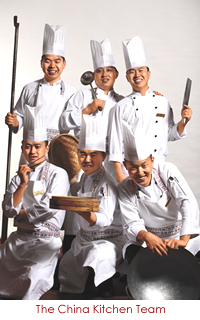
Chinese chefs from Chengdu, Sichuan's culinary capital.
He was trained to be a Continental chef with Hyatt International
but Jack chose to delve deep into his cultural roots.
He travelled through Sichuan to understand
its cuisine and learnt the recipes from old masters –
not surprisingly, the spread at The China Kitchen (and The
China House in Hyatt Mumbai) is rooted in Chengdu's gastronomic
culture, which is fed by a stretch of geography the Chinese
describe as Tianfuzhi guo, which, translated literally,
means 'the country of heaven,' or more often as 'the land
of abundance'. This land of abundance has nurtured a super-abundance
of talent. Finally, we can savour a taste of their breathtaking
creativity.
The reviewer, formerly with the Indian
Wine Academy, is the Executive Editor of the Sunday edition
of the India Today Group's morning newspaper venture. Opinions
expressed in this review are entirely his-editor. |


